Overview
Enterprise AI rarely stalls from a lack of vision; it fails from architectural fragmentation. Traditional software platforms were engineered for periodic human querying, producing static reports and dashboards while leaving AI models isolated from core data repositories. When autonomous AI agents are forced to query external databases across disconnected toolchains, organizations encounter severe latency penalties, governance blind spots, and unpredictable cost escalation. The Teradata Autonomous Knowledge Platform eliminates this data friction by unifying data management, analytics, AI Studio development, and agentic execution into a single continuous system of intelligence. By executing model logic directly where enterprise data resides, the platform transforms enterprise AI from episodic insight generation into continuous, governed operational action.
This video demonstrates how the platform addresses architectural fragmentation and operationalizes enterprise AI across cloud and on-premises environments
Key takeaways
- Continuous agentic execution: Moves enterprise AI beyond passive querying to autonomous sensing, reasoning, and operational execution
- Zero data movement: Teradata Fabric enables federated access across open table formats and multi-cloud repositories without complex ETL pipelines
- Complete AI lifecycle management: Teradata AI Studio incorporates the enterprise agent stack—AgentBuilder, Enterprise MCP, AgentEngine, and AgentOps—to streamline agent creation, governance, and deployment
- Deployment sovereignty: Full feature parity across fully managed Teradata Cloud deployments and private on-premises Teradata Factory infrastructure
The evolution: From static insights to continuous execution
The data friction challenge in enterprise AI
Most traditional enterprise architectures separate data platforms from AI execution engines. When AI agents are forced to query external databases, shuttle data across disparate tools, and maintain separate vector stores, systems incur severe latency, increased costs, and security risks.
Grounding AI agents in enterprise context
The platform addresses data friction by executing AI logic directly within the core data layer. By providing interactive assistance through Tera and establishing unified lineage controls, the platform allows organizations to move from episodic human querying to continuous, machine-driven execution—the foundation of autonomous knowledge.
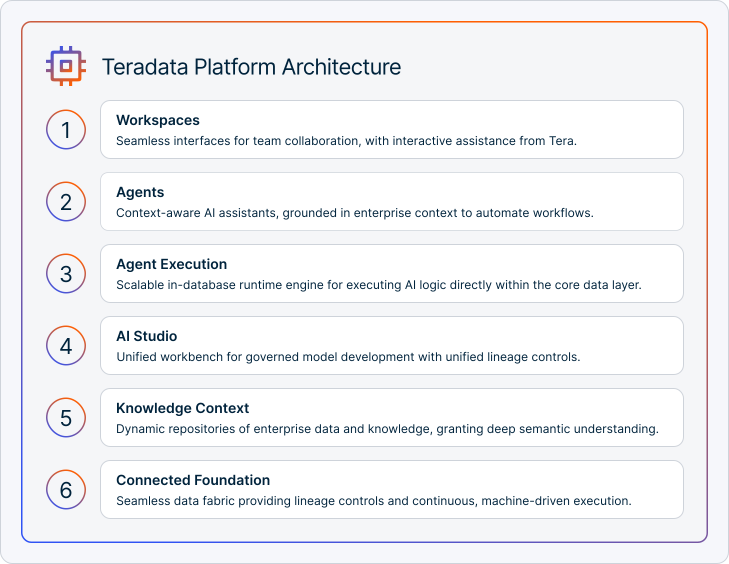
Core architecture of the Teradata Autonomous Knowledge Platform
The platform relies on a connected, multilayered architecture engineered for high-concurrency enterprise workloads.
Connected data foundation and Teradata Fabric
Teradata Fabric unifies structured, semi-structured, and unstructured data across multi-cloud and on-premises environments. Powered by Fabric, organizations achieve high-speed, zero-data-movement query federation across open table formats and cloud object stores.
Knowledge context layer and Enterprise Vector Store
The knowledge context layer establishes business semantics, data lineage, and security rules. Incorporating the Enterprise Vector Store, the platform indexes and manages unstructured data alongside structured analytics inside the platform. This provides trusted context for retrieval-augmented generation (RAG) and multimodal AI applications, with in-database analytic functions keeping context generation at low latency.
Teradata AI Studio and Enterprise AgentStack
Teradata AI Studio provides a unified workspace for data scientists, developers, and engineers to build, fine-tune, and govern models. Its Enterprise AgentStack contributes four core modules:
- AgentBuilder: No-code and pro-code environments for rapid agent development
- Enterprise MCP: Model Context Protocol integration providing secure access to enterprise data
- AgentEngine: Scalable runtime for executing agent workloads
- AgentOps: Operational management for monitoring agent performance, safety, and compliance
High-concurrency agent execution engine
Agentic execution requires continuous compute scaling. The platform uses Active Compute for always-on, low-latency agent reasoning and Elastic Compute for dynamically scalable, compute-heavy model training and batch tasks. Context Engine operates within this framework to sustain contextual continuity across long-running multi-agent interactions.
Flexible deployment: Teradata Cloud and Teradata Factory
The platform reached general availability in July 2026. To support strict data sovereignty, performance, and compliance mandates, Teradata offers full feature parity across deployment environments.
Teradata Cloud infrastructure
Teradata Cloud offers a fully managed, elastic cloud service across public cloud environments, enabling auto-scaling, global accessibility, and automated maintenance while keeping zero-data-movement access to cloud data lakes.
Teradata Factory on-premises architecture
For enterprise workloads bound by strict regulatory constraints or local latency requirements, Teradata Factory provides a pre-integrated, dedicated on-premises infrastructure. Factory combines high-density enterprise storage, high-performance networking, and GPU acceleration powered by Dell Technologies and NVIDIA hardware, enabling private AI operations with operational sovereignty. Data protection across deployments is maintained using Teradata Enterprise Data Protection.
Strategic business outcomes
| Strategic pillar | Traditional AI toolchains | Teradata Autonomous Knowledge Platform |
|---|---|---|
| Operational velocity | Episodic, human-initiated queries | Continuous sensing, reasoning, and autonomous execution |
| Data governance | Siloed across separate vector stores and LLM APIs | Unified lineage, role-based governance, and zero-data-movement safety |
| Cost control | Unpredictable per-token consumption charges | Predictable compute scaling via Active Compute and Elastic Compute |
| Deployment sovereignty | Forced cloud migration or fragmented hybrid setups | Parity across Teradata Cloud and Teradata Factory |
Conclusion
The transition toward the autonomous enterprise requires an architecture built for continuous execution, deep context integration, and zero data movement. By unifying data foundation capabilities, semantic context, and multi-agent orchestration into a single system, the platform provides the infrastructure required to scale enterprise AI safely and cost-effectively. Whether deployed on Teradata Cloud or privately on Teradata Factory, organizations can operationalize agentic AI with confidence.
Ready to move from insight to autonomous action? Explore how the platform can accelerate your AI strategy. Schedule a demo, or start your hands-on experience with Teradata Trial.
Frequently asked questions
How does the Teradata Autonomous Knowledge Platform handle zero data movement?
How does the Teradata Autonomous Knowledge Platform handle zero data movement?
The platform uses Teradata Fabric to execute federated queries across external databases, open table formats, and cloud object stores directly where the data resides. This removes ETL pipelines from the path and reduces the security risks associated with data movement.
What components are included in Teradata AI Studio?
What components are included in Teradata AI Studio?
Teradata AI Studio is an integrated workspace incorporating the Enterprise AgentStack—AgentBuilder, Enterprise MCP, AgentEngine, and AgentOps—alongside the Enterprise Vector Store and model lifecycle tools. It provides an environment to develop, deploy, and govern AI agents.
How does Teradata Factory differ from public cloud deployments?
How does Teradata Factory differ from public cloud deployments?
Teradata Factory is an on-premises, dedicated solution engineered in partnership with Dell Technologies and NVIDIA for organizations with strict data sovereignty or private AI requirements. It offers feature parity with Teradata Cloud while keeping compute and data locally contained.
How does the platform support RAG and vector search?
How does the platform support RAG and vector search?
The Enterprise Vector Store is built directly into Teradata Database, allowing structured corporate data and vector embeddings from unstructured data to be queried together using hybrid search, delivering context to retrieval-augmented generation (RAG) models.