Overview
Medallion architecture is a data design pattern that isolates data into three progressive layers: bronze for raw ingress, silver for cleaned and conformed models, and gold for business-ready delivery. Each hop improves quality and structure, so downstream queries do not read raw sources directly. Analytics and AI consume trusted, read-optimized tables, while the raw history remains intact for audit or pipeline replay.
The Medallion architecture and the layered data warehouse section below maps the layers to the classical warehouse tiers. A medallion design defines how data gets refined, not where it is stored. A layer is a logical checkpoint, not a physical storage array, so it applies to a lakehouse, a classical warehouse, or a hybrid of both.
Key takeaways
- Every layer needs a distinct purpose, an owner, and a quality guarantee
- The pattern remains vendor-neutral, drawing on the staging, integration, and presentation concepts of the classical enterprise data warehouse
- Trade-offs include duplicated storage footprint, pipeline latency, and scope drift, pushing architects to adapt the fixed three-hop model to reality
Medallion architecture as a multi-hop pattern
Medallion architecture is also called “multi-hop,” because data moves from one layer to the next. It usually runs on a lakehouse. Each hop applies a defined set of transformations and checks.
The bronze, silver, and gold layers
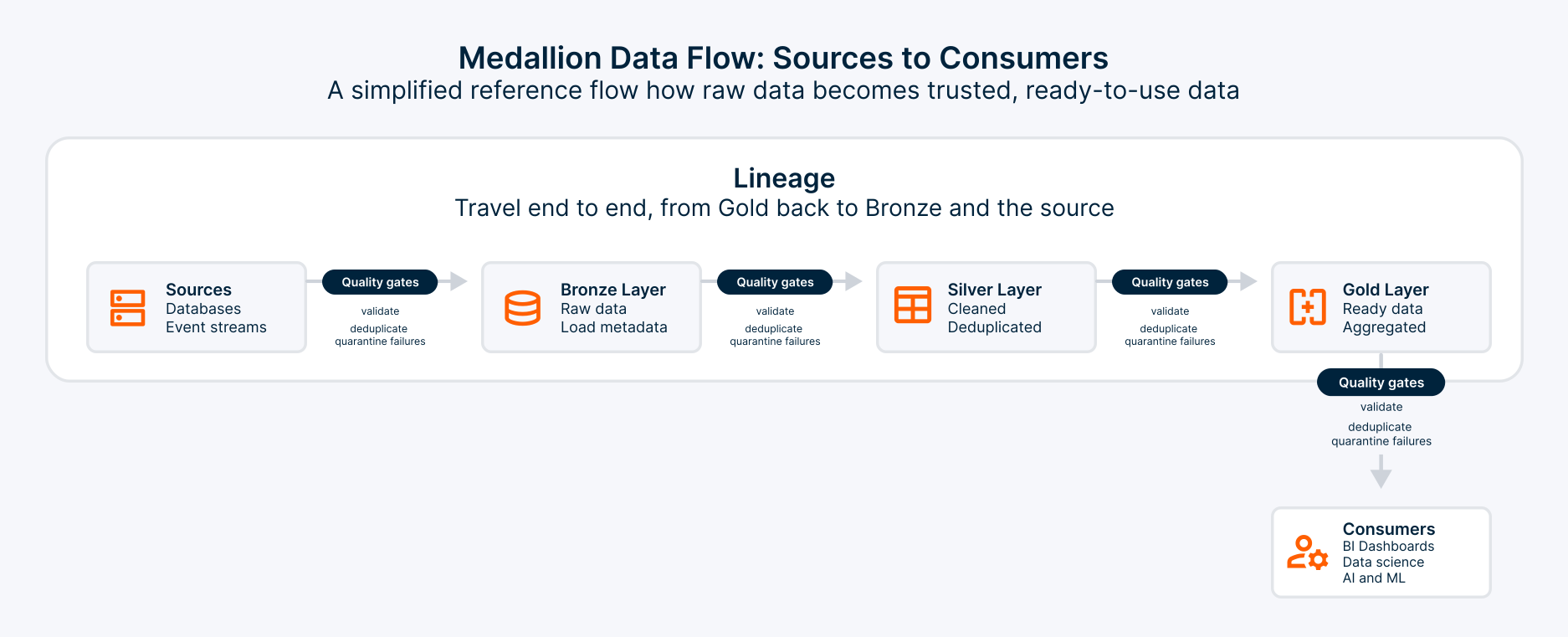
Bronze layer: Raw data as it arrives
The bronze layer absorbs data from source systems exactly as it comes. This includes database extracts, change data capture (CDC) feeds, application logs, flat JSON/CSV files, or raw event streams. Records retain their original schemas, augmented only by load metadata like timestamps, source origins, and process IDs. Because bronze is usually append-only, it preserves the audit history of what arrived, letting teams drop and rebuild corrupted downstream tables without reading the source systems again.
Silver layer: Cleaned, conformed, and validated
The medallion architecture silver layer forces raw records into reliable, conformed data. Pipelines at this boundary enforce hard schemas, drop duplicates, handle nulls, standardize codes and units, and map disparate source records to shared enterprise entities like customers, products, and accounts. Because silver tables remain at the granular detail level rather than rolling up into aggregates, they become the primary workspace for data engineers, data scientists, and analysts who need flexible, validated detail.
Gold layer: Business-ready data
The gold layer curates silver data for distinct consumption patterns, such as dimensional star schemas for BI, pre-aggregated metrics for executive dashboards, dense feature tables for machine learning models, and curated datasets for AI applications. Gold tables fix enterprise business rules, like the exact calculation for recognized revenue. And they optimize for read performance, trading storage for fewer runtime joins and predictable concurrency.
| Dimension | Bronze | Silver | Gold |
|---|---|---|---|
| Purpose | Land and preserve source data | Clean, conform, and integrate | Serve specific business uses |
| Data state | Raw, as delivered, usually append-only | Validated, deduplicated, detailed | Aggregated, modeled, curated |
| Typical model | Source structures plus load metadata | Normalized or Data Vault style | Dimensional (star schemas), feature tables |
| Main users | Data engineers | Data engineers, data scientists, analysts | Business analysts, BI tools, ML and AI applications |
| Change tolerance | Absorbs source changes | Evolves with source and entity changes | Stable definitions with versioned changes |
Here’s a medallion architecture example. A retailer lands point-of-sale transactions and web orders in bronze exactly as each system sends them. In silver, the two feeds are deduplicated, product codes are standardized, and each order is linked to one customer record. In gold, the data becomes a daily sales table by store and product, and a customer feature table for a demand forecasting model.
How data moves through a medallion architecture
Pipelines between layers do two jobs. They transform data, and they decide whether data is fit to move on. The checks are described under Quality gates between layers.
ETL or ELT?
Medallion architecture usually follows an extract, load, transform (ELT) pattern rather than classic extract, transform, load (ETL). Systems dump raw streams into bronze first, executing the heavy transformations natively inside the platform to push records into silver and gold. However, specific hops, like assembling a complex gold aggregate from multiple silver tables, can still rely on heavy ETL-style processing.
Batch and streaming pipelines
The architecture does not require nightly batches. With streaming data, events land in bronze continuously, and incremental pipelines carry new records into silver and gold. Modern open table formats enable this by tracking exact commit histories, allowing downstream jobs to grab only the deltas instead of rescanning whole tables. In production, teams routinely mix both execution modes, streaming the pathways that feed operational BI while batching the heavy historical jobs.
Medallion architecture and the layered data warehouse
Long before the medallion name became common, enterprise data warehouse architects divided environments into a staging area, an integration core, and a presentation tier of data marts. Staging absorbed source extracts, integration conformed them into a fixed enterprise model, and marts served specific departments. Medallion architecture can be mapped to that classical discipline:
| Medallion layer | Traditional warehouse layer | Typical data modeling approach |
|---|---|---|
| Bronze | Staging area / landing zone | Source-shaped tables, often kept only briefly in older designs |
| Silver | Integration layer, operational data store, enterprise data warehouse core | Third normal form or Data Vault for history and auditability |
| Gold | Presentation layer, data marts, semantic layer | Dimensional models (star schemas) and aggregates |
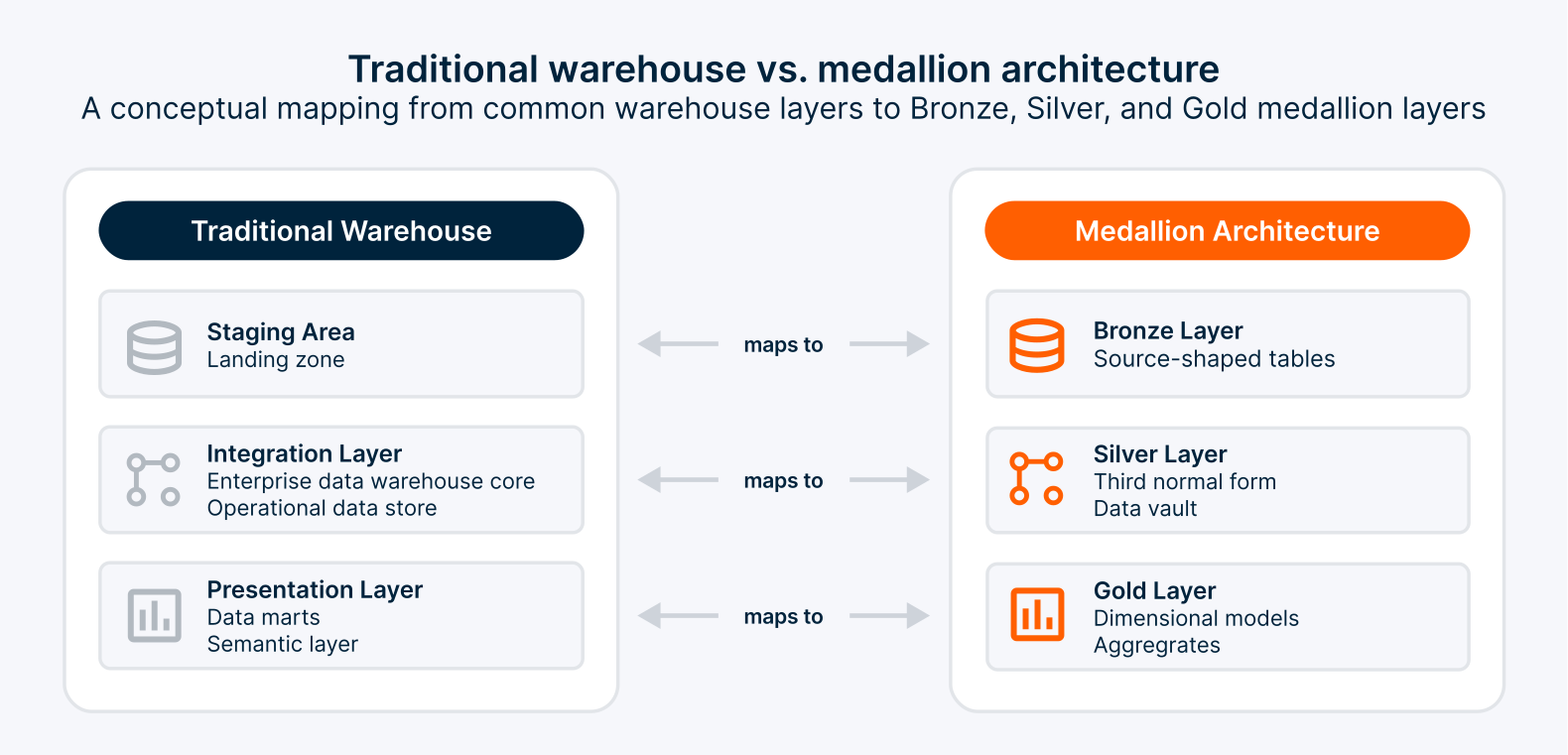
The shift lies in storage economics and open table architectures. Traditional warehouses frequently purged staging zones post-load to avoid disk costs. Cheap object storage now makes it affordable to keep complete raw history. Open table formats like Apache Iceberg and Delta Lake add reliable, database-style transaction support to that storage, whether it sits in a data lake or a data warehouse. For veteran enterprise data warehouse teams, the main difference is a longer-lived raw layer, while the fundamental data modeling paradigms remain unchanged.
Data quality and governance across the layers
The pattern is as much a governance model as a pipeline model. Every layer boundary provides a checkpoint to measure data health, log execution lineage, and apply access controls. Because the pattern is vendor-neutral and widely used as a shared vocabulary, its layer boundaries give teams a standard place to apply these controls.
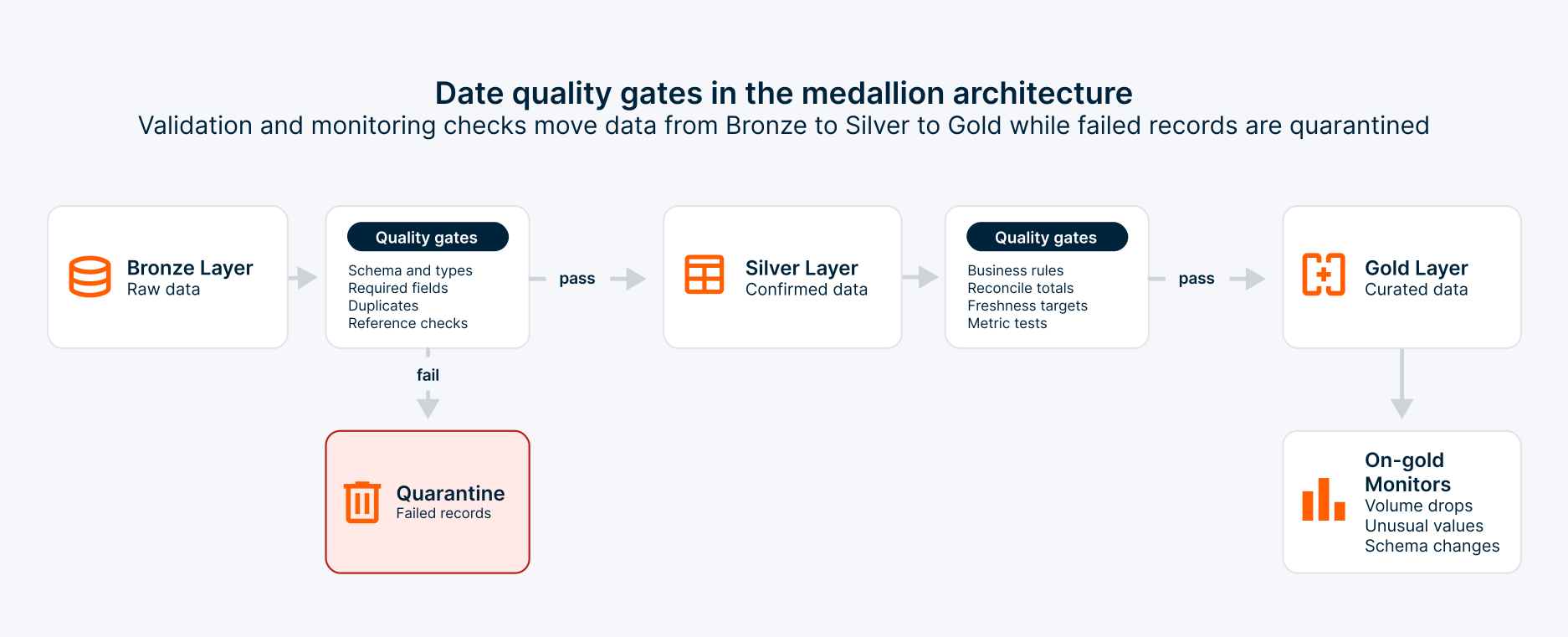
Quality gates between layers
Production environments anchor their data quality checks directly at the transition boundaries, tightening the ruleset as data moves downstream.
- Between bronze and silver: The gates cover schema and type validation, required fields, duplicate detection, referential checks against reference data, and quarantine for records that fail.
- Between silver and gold: The gates cover business-rule checks, reconciliation of totals against source systems, freshness targets, and tests on metric definitions.
- On gold: Monitoring covers volume drops, unusual values, and schema changes that would break dashboards, models, or AI applications downstream.
Lineage, access, and ownership
Because every dataset occupies a clearly defined layer, data lineage traces a suspicious gold metric through silver logic back to the offending bronze source record, compressing root-cause analysis. Access controls naturally tighten upstream. Bronze frequently holds PII and raw data restricted to core engineers, whereas masked gold tables are broadly exposed to the business. Assigning clear layer ownership enforces operational data governance, turning well-documented gold tables into reusable data products with defined semantics and service levels across an open, connected data foundation.
Medallion architecture trade-offs and alternatives
Architects must plan for the following costs and trade-offs:
- Each layer stores another version of the data, so there are more copies and more storage; keeping full bronze history adds up for high-volume sources
- Every hop adds processing time and latency, so a batch-only design can be too slow for operational use cases
- Layers can drift when teams query bronze as if it were clean, or pile business logic into silver until it becomes an undocumented bold layer
- Pipelines that read from several layers at once entangle the layers, which makes lineage hard to follow and changes risky
When to add or remove layers
Three layers are a convention, not a rule. Smaller platforms sometimes merge silver and gold, or skip a persistent bronze layer for sources that can be re-extracted cheaply. Larger ones add layers, like a landing zone in front of bronze for files that have not been registered yet, or a fourth "platinum" layer that some practitioners propose for low-latency operational analytics and premium data products. The test is the same either way. Each layer should have a distinct purpose, owner, and quality guarantee.
Medallion layers in a data mesh
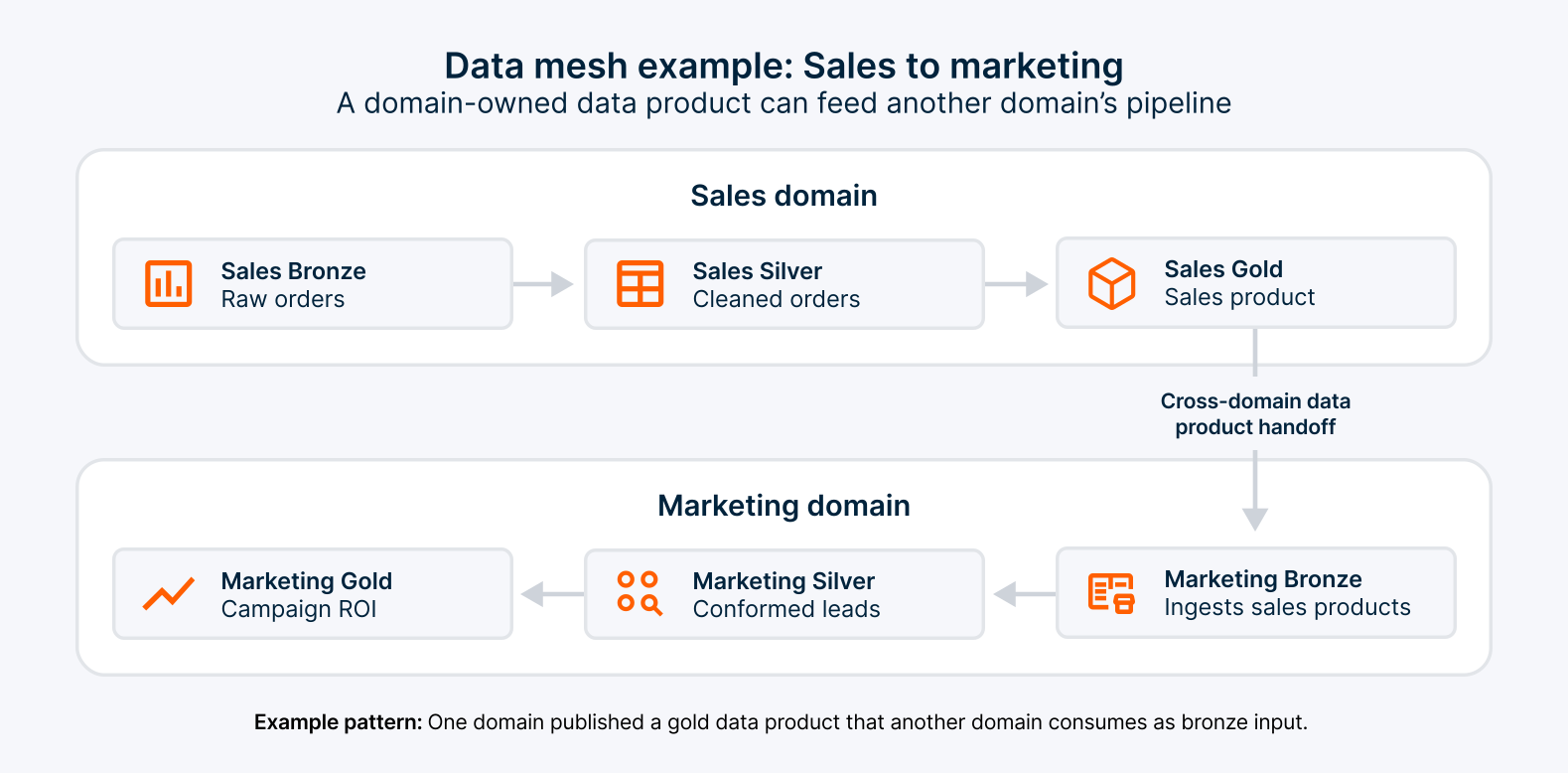
In a data mesh, each business domain can run its own medallion layers and publish its gold tables as data products. A consuming domain can then treat another domain’s gold output as its own bronze input, instead of copying the raw sources again. This federated approach scales across teams but requires shared standards for formats, quality metrics, and naming to prevent domain drift.
Medallion layers on an open, connected data foundation
Medallion architecture gives every dataset a clear place and a clear purpose. Bronze preserves raw history. Silver turns it into clean, conformed detail. And gold delivers business-ready data for analytics and AI. Each layer has an owner, a quality guarantee, and checks at every hop. The pattern applies equally to a lakehouse, a classical warehouse, or a hybrid. Teams should adapt the number of layers to their needs rather than treat three as a rule.
Putting the pattern into practice takes a platform that keeps the layers governed, open, and connected. That means working with open table formats like Apache Iceberg and Delta Lake, supporting lakehouse and enterprise data warehouse workloads side by side, and letting domains share trusted data products without copying data into yet another store.
Layers only build trust when the platform underneath keeps them governed, open, and connected. Learn how the Teradata Autonomous Knowledge Platform brings data, analytics, and AI together on trusted enterprise data.
Frequently asked questions
What is the difference between a medallion architecture and a lakehouse architecture?
What is the difference between a medallion architecture and a lakehouse architecture?
A lakehouse is a storage and processing architecture that adds warehouse-style management and transactions to data lake storage. Medallion architecture organizes data by refinement level. The two are often used together, but each works without the other.
Is medallion architecture still relevant?
Is medallion architecture still relevant?
Yes, as a shared vocabulary and a default structure for data pipelines.
How many layers does a medallion architecture need?
How many layers does a medallion architecture need?
Three is the convention: Bronze, silver, and gold. Some designs merge or add to them, such fourth "platinum" layer that some practitioners use for premium data products.
What is the difference between medallion architecture and data vault?
What is the difference between medallion architecture and data vault?
Medallion architecture organizes data in bronze, silver, and gold layers by how refined it is. Data vault is a modeling method for keeping history and auditability. The two are often combined. A normalized or data vault model commonly sits in silver, and dimensional star schemas often sit in gold.
What is the difference between medallion architecture and a data warehouse?
What is the difference between medallion architecture and a data warehouse?
A data warehouse is where integrated data is stored and modeled. A medallion architecture is a design pattern for refining data in stages, so it can run on a lakehouse, a classical warehouse, or a hybrid. In a warehouse, bronze maps to the staging area, silver to the integration layer and gold to the presentation layer and data marts.