Overview
ETL—short for extract, transform, and load—is the data integration process that moves data from multiple source systems into a data warehouse or other target system, where it can be cleaned, standardized, and made ready for analysis. As enterprises scale cloud analytics, AI workloads, and real-time reporting, a well-designed ETL process remains foundational to delivering accurate, governed data at every stage of the pipeline. Read on for a full definition of ETL, how the ETL process works step by step, how ETL compares to ELT, common use cases and examples, and how to choose the right ETL tool for your organization.
- What it is: ETL (extract, transform, load) is a data integration process that moves data from multiple source systems into a data warehouse or target system for analysis.
- How it works: Three stages—extract raw data from sources, transform it into a consistent format, and load it into the destination.
- When to use it: Governed, compliance-sensitive, or on-premises workloads where data quality control before loading matters more than ingestion speed.
- ETL vs. ELT: ETL transforms before loading; ELT loads raw data first and transforms inside a cloud warehouse. Most enterprises run both patterns side by side.
What does ETL stand for?
ETL stands for extract, transform, and load. It's a data integration process used to consolidate data from multiple sources into a single destination—typically a data warehouse, data lake, or cloud analytics platform—where it can be prepared for reporting, business intelligence, and analytics.
The term dates back to the 1970s, when enterprises first needed a standardized way to combine data from separate transactional systems into a central repository for analysis. Although the tools and target systems have evolved dramatically since then, the core concept—extract, transform, and load—remains central to how organizations move data today.
What is ETL in data warehousing?
ETL, or extract, transform, and load, refers to the process in data warehousing that concurrently reads or extracts unstructured data from the source system—such as a data lake—converts (or transforms) the data into the proper format for querying and analysis, and loads it into an on-site data warehouse, cloud data warehouse, operational data store, or data mart. ETL systems commonly integrate data from multiple applications or systems that may be hosted on separate hardware and managed by different groups or users. ETL is commonly used to assemble a temporary subset of data for ad-hoc reporting, migrate data to new databases, or convert databases into new formats or types.
ETL is important to data warehousing because it allows raw data collection from multiple data sources and centralization for analytics needs. This lets you make faster queries because you're asking questions from a single data source.
How does the ETL process work?
ETL tools automatically consolidate data from one or many sources into one central container. The process involves three steps:
Extract: Pulling data from source systems
The extract phase pulls raw data from multiple source systems, ranging from enterprise applications and relational databases to flat files, APIs, and devices connected to the internet of things (IoT). Data engineers configure the ETL tool to connect to each source, identify which records to extract, and copy them to a staging area where they can be processed without affecting production systems. Because source systems often use different formats, schemas, and update frequencies, reliable extraction is foundational to the success of the rest of the pipeline.
Transform: Cleaning and standardizing data
The transform phase converts raw data into a uniform format suitable for querying and analysis. This can include filtering out incomplete or duplicate records, applying business rules, standardizing formats (such as dates, currencies, or units of measurement), joining data from multiple sources, and aggregating records for reporting. Transformations often convert data into structured query language (SQL)–friendly tables, though modern ETL tools also handle semi-structured formats like JSON. A well-designed transformation step ensures that downstream consumers work from consistent, trustworthy data.
Load: Moving data to the target system
The load phase writes the transformed data into the target system—typically a data warehouse, data lake, data mart, or operational data store. Loading can happen in scheduled batches (for example, a nightly job that updates the warehouse with the previous day's sales data) or in near real-time via streaming pipelines. The target system then becomes the single source of truth for analytics, dashboards, machine learning models, and any other downstream application that depends on consolidated enterprise data.
Types of ETL tools
ETL tools and ETL software come in several forms, each suited to different architectures and operational requirements. The right choice depends on where your data lives, how quickly you need it available for analysis, and whether your workloads are structured and predictable or variable and real-time.
On-premises ETL tools
On-premises tools can allow for better security, as all the data is stored onsite. They offer tighter compliance control because data never leaves your environment, which makes them a common choice for industries with strict regulatory requirements such as financial services, healthcare, and government.
Cloud-based ETL tools
Cloud software is specifically designed for ETL processes that serve cloud-based data warehouses and applications. These tools scale compute and storage on demand, integrate natively with modern SaaS sources, and reduce infrastructure overhead—which makes them well-suited to organizations running analytics on platforms like Snowflake, Amazon Redshift, Google BigQuery, or Microsoft Azure.
Batch ETL tools
Batch software conducts the ETL process in batches, which is ideal for regular analytics and reporting of structured data—like payroll information. Batch jobs typically run on a schedule such as nightly or hourly, processing accumulated data in large chunks, and they're a strong fit for predictable workloads like monthly financial reports or end-of-day sales totals.
Real-time and streaming ETL tools
Real-time ETL tools minimize the amount of time it takes to gather and analyze information in the data pipeline. They process data continuously as events occur, which makes them essential for use cases like fraud detection, IoT monitoring, recommendation engines, and any application that depends on up-to-the-second insights.
Benefits of ETL
ETL delivers several important benefits for organizations that need to consolidate and analyze data from across the business.
Unified view of enterprise data
By consolidating data from multiple source systems into a single target, ETL gives analysts, executives, and business users a unified view of operations, customers, and performance. Instead of pulling reports from siloed tools with inconsistent definitions, teams query a single, reconciled source of truth—which reduces the risk of conflicting numbers showing up in different parts of the business.
Improved data quality and consistency
Through the proper use of ETL, data exists in a uniform format that can be easier to track through an enterprise's data pipelines and overall architecture. The transformation phase applies cleansing, validation, and standardization rules that catch errors, remove duplicates, and enforce consistent formats before data reaches downstream systems—which means analysts and applications work from trustworthy records.
Supports business intelligence and analytics
Business intelligence is a broad term that encompasses data mining, process analysis, performance benchmarking, and descriptive analytics. Without ETL, businesses would have great difficulty compiling and analyzing data for BI. ETL allows companies to make complex queries and get prompt responses that help them make better decisions.
Accelerates cloud migration and modernization
The ETL process allows you to pull data from many disparate sources and transfer them to a centralized data warehouse or analytics platform. Without ETL tools, this can be exceptionally difficult and time-consuming, especially if you're working with many diverse data sources and types.
Reduces manual effort through automation
Automation tools make it possible to perform ETL without constant monitoring. This is especially true for enterprise-scale businesses that process large amounts of data each day. Automated ETL tools also protect data teams from the risks associated with human error.
Challenges of ETL
Despite its value, ETL also comes with a few important challenges:
- Lack of scalability. ETL relies on predictable data sources that don't change much to function. If you change your IT environment, you'll need to tweak your ETL testing processes so they can keep up.
- Transformation leading to flawed or inaccurate data if not tested for quality and explored before the process begins. ETL tools are complex and require a great deal of expertise to function properly. Without proper testing, cleansing, and exploration, errors may find their way into the data.
- Conflicting ideas about ETL. Both data analytics and data engineering are vital for all data teams, but they serve separate purposes. Data scientists perform data analysis using tools such as machine learning (ML) in the realm of data science. Data engineers work with raw data to turn it into useful information for decision-making.
ETL vs. ELT: What's the difference?
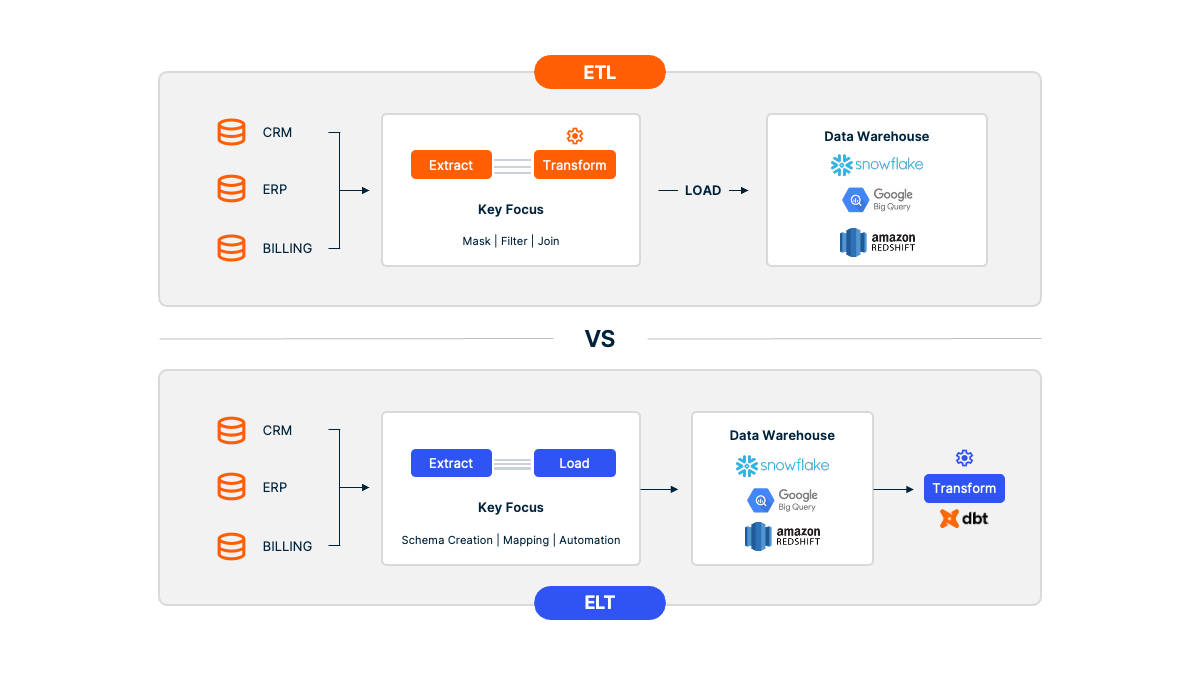
Extract, load, and transform (ELT) is a variation of the ETL pipeline, often used in cloud-based environments. Instead of transforming data before loading, ELT ingests and stores raw data in a data warehouse or data lake, where it can be transformed later as needed for analysis.
Because transformation happens after loading, ELT can improve speed and flexibility, particularly in cloud-native architectures that support large-scale data processing and on-demand compute.
Source: https://www.striim.com/blog/etl-vs-elt-differences/
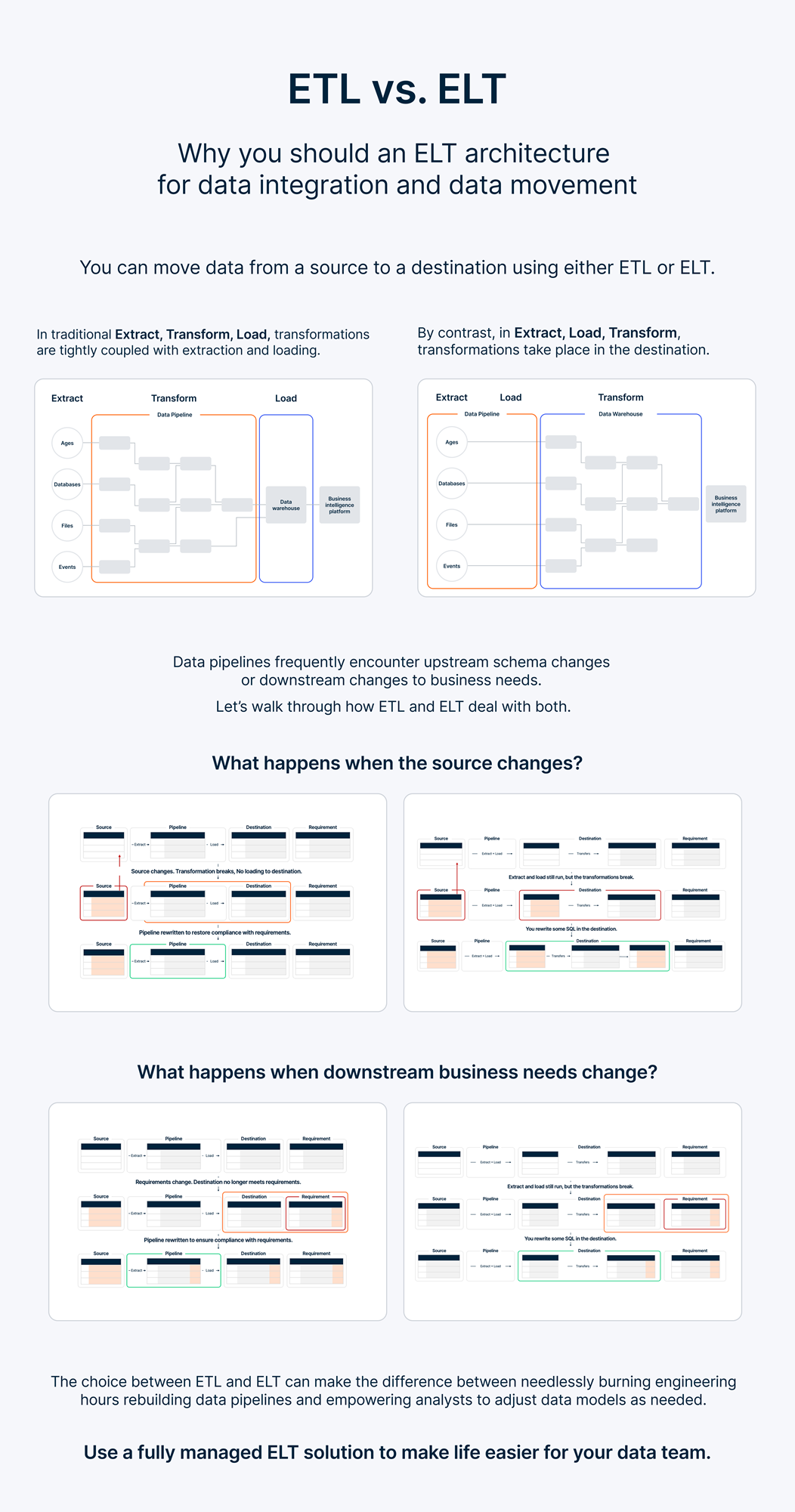
While ETL and ELT follow similar steps, they differ in how and when data is transformed, where the compute happens, and which workloads each is best suited for. The table below summarizes the key differences between ETL and ELT across processing, architecture, cost, governance, and common use cases.
Source: https://www.linkedin.com/posts/salim-raj-kapoor-184b8b255_100daysofdataengineering-dataengineering-activity-7426818388519370752-FPMj/
In general, ETL is preferred for structured, controlled environments, while ELT is better suited for scalable, cloud-based analytics.
When to use ETL
Choose ETL when your workloads require strict governance, predictable performance, and well-defined business rules applied before data reaches the warehouse. ETL is a strong fit for regulated industries such as financial services, healthcare, and government where compliance requirements demand that sensitive data is validated and standardized in a controlled staging environment before loading. It also suits organizations running primarily on-premises data warehouses, those with stable reporting requirements, or teams prioritizing workload isolation and cost predictability over raw ingestion speed.
When to use ELT
Choose ELT when your data volumes are large, your sources are varied, and your target system is a modern cloud data warehouse or data lake with elastic compute. ELT fits workloads where flexibility matters—for example, data science and machine learning pipelines that benefit from keeping raw data accessible for reprocessing, or analytics teams that want to iterate on transformations in SQL inside the warehouse. ELT is also well-suited to organizations standardizing on cloud-native stacks.
Common ETL use cases and examples
ETL supports a wide range of enterprise data workloads. Below are four of the most common use cases organizations rely on ETL for today.
Data warehouse integration and consolidation
The most established ETL use case is building and maintaining an enterprise data warehouse. Organizations extract data from CRM, ERP, finance, marketing, and operational systems, transform it into consistent formats, and load it into a central warehouse where it can be analyzed collectively. This consolidated view is the foundation for executive dashboards, financial consolidation, and cross-functional reporting that would be impossible to produce from siloed source systems.
Cloud migration and hybrid architectures
ETL plays a critical role in moving data from legacy on-premises systems to modern cloud platforms. During a cloud migration, ETL pipelines extract data from aging databases, transform it to fit new target schemas, and load it into cloud warehouses or data lakes—often in phased waves that let the legacy and cloud systems run in parallel. ETL is also essential in ongoing hybrid architectures where some data remains on-premises for compliance or latency reasons while other workloads run in the cloud.
Business intelligence and reporting
ETL pipelines feed the clean, standardized data that powers BI tools, self-service analytics platforms, and executive reporting. Finance teams use ETL-prepared data for monthly close and budgeting; sales and marketing teams use it for pipeline analysis and campaign attribution; operations teams use it for KPI dashboards. Without ETL, each team would need to run its own extraction and cleaning logic, leading to inconsistent numbers, wasted effort, and competing versions of the truth.
Machine learning and AI data pipelines
Modern ETL increasingly supports machine learning and AI workloads. ML models depend on consistent, well-governed training data, and ETL pipelines are how that data is prepared—extracted from operational systems, cleaned and standardized, and loaded into feature stores or model training environments. As enterprises build out generative AI and predictive analytics use cases, reliable ETL is what ensures models are trained on trustworthy, lineage-tracked data rather than ad-hoc extracts.
How to choose the right ETL tool
When choosing ETL tools, there are a few factors to consider. Your ETL tool should have:
- Comprehensive monitoring features. A detailed illustration of progress when performing ETL tasks is vital for maximum transparency.
- Effective error handling. If something goes wrong, the ETL tool should be able to explain why. In addition, it should have preventative measures against data loss.
- Scalability. If you expect your business to grow, your tools should be able to grow with you. An ETL tool that can't handle increasing amounts of data isn't going to be useful for long.
- An easy-to-use interface. The most advanced ETL tool on the market is of little help if its UI makes no sense. Your data integration tool should be bug-free, reliable, and easy to set up.
- Compatibility with various data sources. If you need to gather data from a wide range of containers, whether a data warehouse or database, your tool should be able to work with all of them without a hitch. It should also be able to work seamlessly with a variety of cloud services.
ETL has specific uses, but it's generally not a suitable approach to big data on its own. Instead, it should be part of a larger strategy that accounts for current data trends and constantly shifting processes.
Frequently asked questions
Still have questions about ETL? Here are answers to some of the most common.
Is ETL still relevant in modern data architectures?
Is ETL still relevant in modern data architectures?
Yes—ETL remains central to modern data work, though its role has evolved. While ELT has become the default pattern for cloud-native analytics and data science workloads, ETL is still the right choice for regulated, governed, and on-premises workloads where strong control over data quality before loading is required. Many enterprises run both patterns side by side, using ETL for sensitive financial or compliance-critical pipelines and ELT for high-volume, flexible analytics and AI use cases.
What is an ETL pipeline?
What is an ETL pipeline?
An ETL pipeline is the set of connected processes and tools that move data from source systems through the extract, transform, and load stages to a target system. A single ETL pipeline might handle a specific data flow—for example, pulling daily sales records from a point-of-sale system, cleaning them, and loading them into a sales reporting warehouse—while a larger enterprise typically runs dozens or hundreds of pipelines across different data domains.
How is ETL different from data integration?
How is ETL different from data integration?
Data integration is the broader category—any process that combines data from multiple sources into a unified view. ETL is one specific approach to data integration, characterized by the three-stage extract, transform, load sequence. Other data integration approaches include ELT, data virtualization, change data capture (CDC), and data replication. ETL is the most established of these and is particularly well-suited to batch-oriented analytics workloads where transformed, curated data is the target.
What does an ETL developer do?
What does an ETL developer do?
An ETL developer designs, builds, and maintains the pipelines that move data from source systems to target systems. The role involves writing extraction logic, defining transformation rules, optimizing performance, monitoring pipeline health, and troubleshooting failures. ETL developers typically work with tools like Informatica, Talend, SSIS, dbt, or cloud-native services, and they collaborate closely with data engineers, data analysts, and business stakeholders to ensure pipelines deliver accurate data on schedule.