Overview
The enterprise artificial intelligence landscape has reached a critical inflection point. While capital expenditure on generative models and machine learning continues to hit record highs, standard industry benchmarks reveal a persistent execution gap: 72% of enterprise AI investments fail to deliver measurable ROI, driven primarily by tool sprawl, unmanaged “shadow AI,” and isolated data silos. Furthermore, while over 75% of organizations deploy AI in at least one business function, only 31% of prioritized AI use cases ever reach full production.
To bridge the gap between AI experimentation and sustainable business value, market leaders are shifting from static, conversational chatbots to agentic AI—autonomous systems capable of multistep reasoning, decision-making, and complex execution. Achieving enterprise AI maturity requires moving beyond fragmented point tools and grounding autonomous agents in trusted business context, robust data governance, and high-performance analytics at scale powered by Teradata Cloud.
Key takeaways
- Address the execution gap: moving from pilot projects to production ROI requires replacing fragmented point tools with a unified platform strategy
- Ground agentic workflows: autonomous AI agents require trusted enterprise context to prevent hallucinations and execute reliable business decisions
- Optimize compute costs: separating workloads between always-on Active Compute and on-demand Elastic Compute supports predictable operational scaling
- Enforce unified governance: native in-database analytics and centralized data fabrics maintain security, compliance, and end-to-end data lineage
The 5 pillars of enterprise AI maturity
To operationalize AI at scale, technology leaders evaluate organizational capability across five core pillars supported by Teradata Cloud.
1. Strategic alignment and ROI discipline
Mature enterprises discard point-solution experimentation in favor of high-impact business outcomes. By focusing on mission-critical use cases—such as real-time fraud reduction, supply chain optimization, and automated customer experience analysis—organizations establish clear ROI metrics before deploying capital.
2. Unified open data fabric
AI models require real-time access to enterprise data across multi-cloud and hybrid environments. Teradata Fabric with open table formats such as Apache Iceberg and Delta Lake allows organizations to query data directly where it lives without incurring costly data movement or vendor lock-in. Fabric streamlines multi-cloud data sharing while maintaining centralized security.
3. In-database analytics and acceleration
Moving massive enterprise datasets to external AI engines creates latency, security risks, and inflated egress costs. Executing analytics and machine learning functions natively within the Autonomous Knowledge Platform brings model scoring, vector search, and data transformation directly to the data, removing unnecessary data transfers and accelerating machine learning pipelines at scale.
4. Comprehensive governance and context
Autonomous AI agents require strict operational guardrails. Tera Context Engine allows organizations to combine structured business metrics with unstructured documents, customer interactions, and vector embeddings. Enterprise governance frameworks enforce data lineage, role-based access control, and model transparency—keeping decisions compliant with global regulatory standards.
5. Operationalizing agentic AI
The final stage of AI maturity moves beyond static conversational chatbots to self-managing agentic workflows. With Teradata AI Studio, enterprises build, test, and orchestrate autonomous agents grounded in trusted enterprise context. AI Studio provides developers with agent frameworks and model lifecycle oversight to scale AI execution safely.
Evolution of enterprise AI capabilities
Organizations progress through five distinct operational stages as they scale their analytics and AI infrastructure:
| Maturity stage | Analytics architecture | Primary AI/ML capability | Operational focus |
|---|---|---|---|
| Stage 1: Exploring | Disconnected data marts | Desktop prompts and basic scripts | Isolated experimentation and ad-hoc research |
| Stage 2: Experimenting | Standalone data lakes | Basic predictive models and isolated chatbots | Pilot projects with limited data integration |
| Stage 3: Scaling | Multi-cloud data lakehouse | Extended ML pipelines and vector search | Formal AI center of excellence with centralized governance |
| Stage 4: Optimizing | Integrated data fabric via Teradata Fabric | Native in-database model execution via Autonomous Knowledge Platform | Scaled production deployments on Teradata Cloud |
| Stage 5: Autonomous | Teradata Autonomous Knowledge Platform | Multi-agent autonomous workflows via Teradata AI Studio | Enterprise-wide agentic decision-making |
How industry leaders scale AI with Teradata
Across enterprise AI engagements in financial services, healthcare, manufacturing, and the public sector, Teradata provides the context foundation and performance backbone required for operational AI on Teradata Cloud.
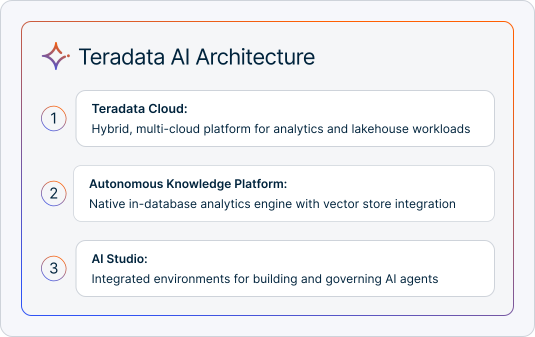
Diagram of the Teradata AI architecture: Teradata Cloud, Teradata Autonomous Knowledge Platform, and Teradata AI Studio, supporting cloud analytics, in-database AI, and governed agent development.
On-demand prototyping with Elastic Compute
Data scientists and engineers need self-service environments to prototype AI models without affecting production business systems. Elastic Compute within Teradata Cloud lets teams spin up scalable, isolated processing nodes on demand, experiment using open-source tools, and move production-ready pipelines into enterprise operations without infrastructure friction.
Grounding AI agents with Teradata AI Studio
Generative AI and autonomous agents depend on accurate enterprise data to avoid hallucinations. With Teradata AI Studio, developers construct multi-agent workflows connected to Autonomous Knowledge Platform and Tera Context Engine. AI Studio unifies enterprise metrics with unstructured text and vector search, supplying agents with the business context they need for accurate decision-making.
Predictable cost management with Active Compute
Unchecked AI compute costs deplete operational budgets. Using Active Compute for mission-critical, always-on analytics workloads alongside Elastic Compute for peak, on-demand processing lets organizations hold performance service levels while governing cloud infrastructure spending.
Next steps for enterprise AI leaders
Bridging the gap between AI ambition and production value requires a modern data foundation and a governed platform built for scale.
- Audit your data readiness: evaluate your enterprise data architecture to remove silos, integrate open table formats, and streamline model access using Teradata Fabric
- Streamline agent development: enable data science teams with Teradata AI Studio to build, test, and deploy governed agentic workflows
- Test platform capabilities: explore preloaded industry use cases and hands-on analytics environments with Teradata Trial
Conclusion
Scaling enterprise AI from isolated pilot projects to autonomous, agentic execution requires moving past fragmented point tools and ungoverned data silos. By uniting hybrid data infrastructure, native in-database analytics, and governed multi-agent orchestration across Teradata Cloud and Autonomous Knowledge Platform, organizations establish the context foundation required to drive repeatable business outcomes.
Frequently asked questions on enterprise AI maturity
What is the role of the Autonomous Knowledge Platform in scaling enterprise AI?
What is the role of the Autonomous Knowledge Platform in scaling enterprise AI?
Teradata Autonomous Knowledge Platform acts as the core analytics engine that processes complex data workloads, vector search, and machine learning functions directly where data resides. Executing analytics natively within Teradata database removes unnecessary data movement, lowers latency, and maintains data governance across multi-cloud environments.
How does Teradata AI Studio support agentic AI workflows?
How does Teradata AI Studio support agentic AI workflows?
Teradata AI Studio provides an integrated development and operational environment for building, deploying, and managing AI agents. It includes agent-building tools, model management, and standardized integration layers that connect autonomous agents to trusted enterprise data without sacrificing security or oversight.
What is the difference between Active Compute and Elastic Compute?
What is the difference between Active Compute and Elastic Compute?
Active Compute is dedicated, always-on processing capacity designed for baseline, high-concurrency production workloads and core enterprise reporting. Elastic Compute provides on-demand, dynamically scalable compute clusters that scale for burst workloads, ad-hoc data science tasks, and periodic model training.
How does Teradata Fabric simplify multi-cloud data access?
How does Teradata Fabric simplify multi-cloud data access?
Teradata Fabric creates a unified data access layer across hybrid and multi-cloud environments. It allows users and automated workflows to query data stored in disparate systems, data lakes, and open table formats such as Apache Iceberg without physically copying or moving the data.