Overview
AI agent tools are the capabilities that let AI agents do more than generate text—they're the functions, APIs, data connectors, and code interpreters an agent calls to query databases, retrieve documents, invoke external services, and take real action. The term covers both the tools an agent uses at runtime and the tools developers use to build agents; this guide covers both, but focuses primarily on the former.
As enterprises move from chatbots to autonomous agents, the tools an agent can access—and the data those tools connect to—determine whether the agent is a demo or a dependable part of the business.
What are AI agent tools?
AI agent tools are the executable capabilities an AI agent can invoke to interact with the world beyond its own reasoning. If the reasoning model is an agent's brain, its tools are its hands: they let the agent query a database, look up a document, call a SaaS API, run code, or trigger a business workflow.
The phrase is used in two overlapping ways, and readers often conflate them:
- Tools an agent calls at runtime: The functions exposed to the agent's reasoning model, which it selects and invokes as it works through a task. This is the primary meaning and the focus of this page.
- Tools developers use to build agents: The frameworks, libraries, and platforms engineers rely on to assemble agents in the first place. These are covered later in this article.
What separates modern agent tools from traditional function calling is autonomy. A classic application calls a function when the programmer decides to. An agent decides on its own which tool to call, in what order, and when to chain several calls together to complete a multi-step task.
In short: AI agent tools are the callable capabilities—retrievers, queries, APIs, code execution, and custom functions—that an agent selects and invokes to complete a task.
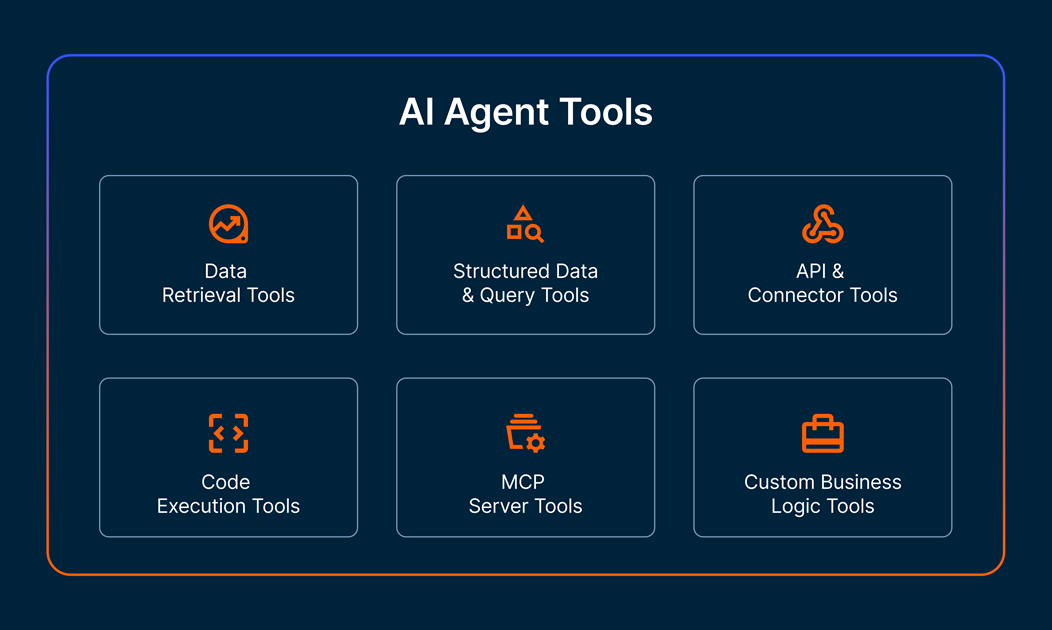
The core types of AI agent tools
Agent tools fall into a small number of recognizable categories regardless of the vendor or framework in use. Most production agent systems combine several of them, because few real tasks can be completed with only one kind of capability. The six categories below cover most of what agents do in enterprise settings:
Data retrieval tools
Data retrieval tools let agents pull relevant unstructured content into their reasoning context. The most common pattern is retrieval augmented generation (RAG), where an agent queries a vector index, a semantic search engine, or a document store to find passages that inform its next step. These tools are how agents answer questions grounded in knowledge bases, internal wikis, policy documents, and other text corpora that won't fit inside a model's context window.
Structured data and query tools
Structured data tools give agents access to governed enterprise data—the tables, warehouses, and lakehouses where customer records, transactions, and operational data live. In practice this means SQL execution tools, database connectors, and query interfaces that let an agent ask precise questions against trusted sources. The quality of these tools matters more than most teams realize: an agent that can query production data but can't respect access controls, row-level security, or data lineage is a governance incident waiting to happen. This is the category where enterprise requirements diverge sharply from demoware.
API and connector tools
API and connector tools wrap external services so an agent can invoke them like any other capability. This covers REST API calls, webhooks, and pre-built integrations with SaaS platforms—ticketing systems, CRMs, payment processors, monitoring tools, and so on. Authentication is the quiet complexity here: production deployments need to handle OAuth flows, API key rotation, and scope-limited credentials so that an agent only touches what it's authorized to touch.
Code execution tools
Code execution tools give agents a sandboxed runtime—typically Python—where they can compute, transform data, run statistical calculations, or generate charts on the fly. Agents fall back on code execution whenever a task needs arithmetic, deterministic transformations, or outputs the reasoning model can't reliably produce by itself. Sandboxing matters here: a code interpreter with unconstrained filesystem or network access is a security liability.
MCP server tools
MCP server tools expose capabilities through the Model Context Protocol, an open standard for how agents connect to external tools and data. An MCP server packages a set of related tools—say, all the operations on a database, or all the endpoints of an internal API—and advertises them through a consistent interface. Managed MCP servers handle the plumbing for common systems; custom MCP servers let teams wrap proprietary logic in the same shape. MCP is increasingly the default way enterprise teams expose tools to agents, because it standardizes what used to be a patchwork of bespoke function-calling schemas.
Custom business logic tools
Custom business logic tools wrap the proprietary rules, workflows, and calculations that define how a specific organization operates—discount approval logic, claims routing rules, escalation policies, pricing algorithms. These can't be bought off the shelf because they encode decisions that are unique to the business. Teams typically build them as callable functions or expose them through a custom MCP server, so the agent can invoke them exactly the way it invokes any other tool.
How AI agent tools work
An agent doesn't execute tools in a single pass. It works in a loop: reason, pick a tool, call it, read the result, decide what to do next. That loop is the defining feature of an agent and the reason agent systems behave differently from traditional chatbots or one-shot LLM calls.
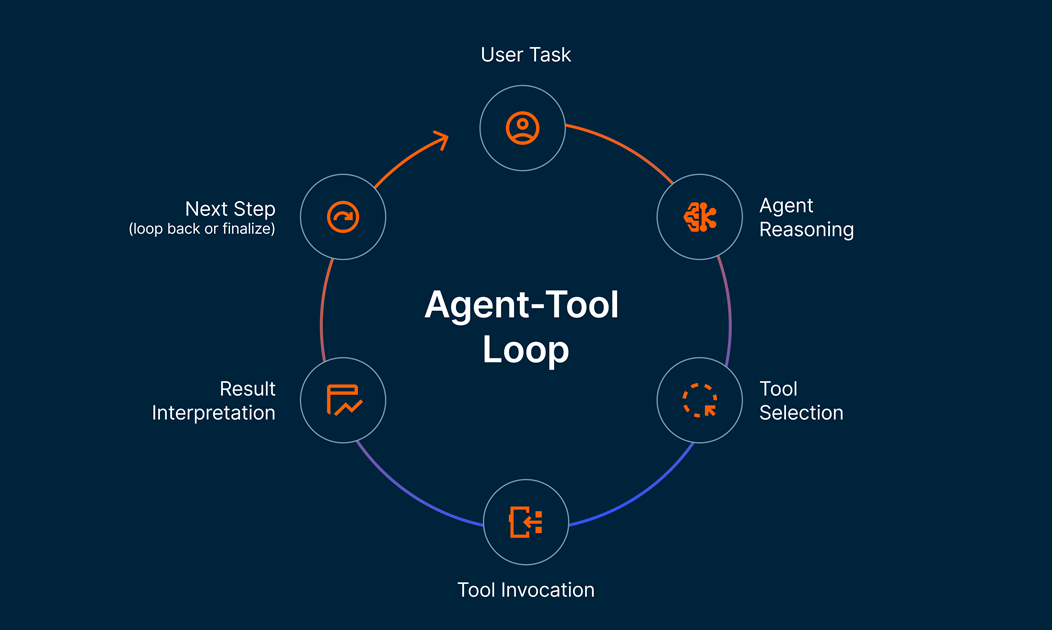
A typical interaction looks like this:
- Task arrives: The agent receives a goal—a user request, a triggered event, or a handoff from another agent.
- Reasoning: The agent's model evaluates what it needs to do first. It considers the tools available to it and picks one.
- Tool selection: The model produces a structured call—the tool name plus its arguments—based on the tool's schema.
- Tool invocation: The chosen tool runs: a query executes, an API returns, code runs, a retriever pulls documents.
- Result interpretation: The agent reads the tool's output, decides whether the task is complete, and either returns a final response or picks the next tool.
- Loop: Steps 2 – 5 repeat until the agent decides it's done or hits a stopping condition.
Agents know what tools are available—and how to call them—through tool descriptions, typically expressed as JSON schemas, OpenAPI specs, or MCP tool definitions. Each description tells the model the tool's name, what it does, what inputs it needs, and what it returns. The reasoning model uses these descriptions at runtime to pick the right tool for the current step.
AI agent tools vs. agent frameworks vs. agent platforms
A lot of writing about AI agents uses "tools," "frameworks," and "platforms" interchangeably, which is why the topic feels confusing to anyone new to it. These are three distinct things that sit in a layered relationship.
The relationship is nested, not competitive. Tools are the runtime primitives an agent uses. Frameworks are the libraries developers use to wire up those tools into an agent. Platforms are the managed environments where frameworks and tools run in production. An organization can use all three at once—and most do.
AI agent tools and the Model Context Protocol (MCP)
The Model Context Protocol is an open standard for how AI agents connect to tools and data sources. Instead of every framework inventing its own tool-calling format, MCP defines a consistent contract: a server exposes tools, an agent client discovers and invokes them, and both sides speak the same language.
This matters for three practical reasons:
- Standardization: A tool exposed via MCP can be used by any MCP-compatible agent without rewriting the integration. Teams stop duplicating work across frameworks.
- Reusability: Managed MCP servers cover common systems—databases, file stores, APIs—so teams don't have to build those tools from scratch. Custom MCP servers let teams expose proprietary logic with the same reusable shape.
- Security boundaries. Because MCP servers sit between the agent and the underlying system, they're a natural place to enforce access controls, logging, and policy checks without changing the agent itself.
MCP is quickly becoming the default way enterprise teams expose tools to agents. Proprietary function-calling still exists and still works, but the direction of travel is toward standardized, reusable, policy-aware tool servers.
Enterprise considerations for AI agent tools
An agent tool is only as trustworthy as the data it touches and the governance around it. A tool that works perfectly in a demo can be a liability in production if it bypasses access controls, skips audit logs, or silently fails in ways the agent doesn't notice. Enterprise teams should evaluate agent tools along the dimensions below before putting them in front of real data or real users.
Here’s what to look for in enterprise-grade AI agent tools:
- Trusted data access: Tools connect to governed, production-quality data sources rather than ad hoc copies
- Access controls: Role-based permissions and row- or column-level security are respected at the tool layer, not bypassed by it
- Auditability: Every tool call is logged with its inputs, outputs, and the reasoning that led to it
- Data lineage: Teams can trace what data an agent touched, where it came from, and how it was used
- Latency and cost monitoring: Observability into per-tool performance and spend, not just whole-system aggregates
- Policy enforcement: Guardrails that define which tools an agent can call in which contexts, enforced automatically
- Graceful failure handling: Tools surface errors clearly rather than returning malformed results the agent interprets as success
How to measure AI agent tool effectiveness
Few teams define measurable outcomes for their agent tooling, which is why many agent pilots stall out. The metrics below are a practical starting point:
- Tool call success rate: Share of tool invocations that return valid, usable results
- Average tool latency: Time from invocation to result, measured per tool
- Cost per agent task: Total spend—model calls plus tool calls—to complete a typical workflow
- Time to integrate: How quickly a new tool can be added to the agent's toolkit
- Policy coverage: Share of tool calls subject to governance and access enforcement
- Tool reuse rate: How often the same tool serves multiple agents across the organization
Selecting AI agent tools for your use case
Picking the right tools for an agent is less about chasing the "best" tool and more about matching capabilities to the task.
A practical sequence:
- Start with the task: What does the agent actually need to do? Specific outcomes, not general capabilities.
- Map tasks to tool categories: Which of the six tool types does the task require—retrieval, structured query, API, code, MCP, custom logic, or some combination?
- Decide build vs. buy per tool: For each required tool, evaluate whether a managed MCP server, a framework-native tool, or a custom build is the right answer. Cost, maintenance burden, and governance fit all matter.
- Validate governance and observability before production: Confirm that each tool respects access controls, produces audit logs, and exposes enough telemetry to diagnose failures.
Teams that work through these four steps explicitly ship agents that make it to production. Teams that skip ahead to tool selection without mapping the task end up with brittle prototypes.
Frequently asked questions
Still have questions about AI agent tools? Here are answers to some of the most common.
What are tools for AI agents?
What are tools for AI agents?
Tools for AI agents are the executable capabilities an agent can call during a task—functions, APIs, database queries, retrievers, code interpreters, and custom business logic. They extend the agent beyond text generation and let it take real action: look up information, query data, invoke services, or run code.
What are the main types of AI agent tools?
What are the main types of AI agent tools?
The main types of AI agent tools are data retrieval tools (for unstructured content), structured data and query tools (for governed enterprise data), API and connector tools (for external services), code execution tools (for computation and transformation), MCP server tools (standardized tool interfaces via the Model Context Protocol), and custom business logic tools (for proprietary rules and workflows).
What's the difference between AI agent tools and AI agent frameworks?
What's the difference between AI agent tools and AI agent frameworks?
AI agent tools are the runtime capabilities an agent invokes to get work done. AI agent frameworks are the developer libraries—like LangChain, LlamaIndex, CrewAI, and AutoGen—used to assemble agents in the first place. Tools are what the agent uses; frameworks are what developers use to build the agent.
Are there open-source AI agent tools?
Are there open-source AI agent tools?
Yes. Open-source options include community MCP servers for common systems, built-in tool libraries inside frameworks like LangChain and LlamaIndex, and public catalogs of reusable tools. Most production deployments mix open-source tools for standard capabilities with custom tools for proprietary logic.
How do AI agents know which tool to use?
How do AI agents know which tool to use?
Each tool comes with a description—typically a JSON schema, OpenAPI spec, or MCP tool definition—that tells the agent what the tool does, what inputs it needs, and what it returns. The agent's reasoning model reads these descriptions at runtime and selects the appropriate tool for the current step based on the task and the available options.