Overview
An AI data pipeline is an automated system that ingests, prepares, and delivers structured and unstructured data to train, ground, and operate artificial intelligence and machine learning models. Unlike traditional data pipelines built for dashboards and reports, AI data pipelines are engineered for multimodal data, stricter lineage requirements, and the continuous retraining cycles that modern AI workloads demand.
A well-designed AI data pipeline moves data through five distinct stages—ingestion, preparation, training or indexing, deployment, and monitoring—each purpose-built to keep models accurate, governed, and production-ready.
What is an AI data pipeline?
An AI data pipeline is the automated infrastructure that moves data from its source systems into a form that artificial intelligence and machine learning models can use. It is responsible for ingesting raw data, cleaning and transforming it, and delivering it—at the right moment, in the right format—to the models that depend on it. In production, the pipeline does not stop once the data has been delivered. It continues to monitor model behavior, detect drift, and route fresh data back into training, closing the loop between the data platform and the AI applications it supports.
The rise of enterprise AI has changed what a pipeline is expected to do. A traditional data pipeline is optimized to move rows of structured data into a warehouse for analysis. An AI data pipeline is optimized for something broader. It must accommodate unstructured sources such as documents, images, audio, and streaming telemetry; generate embeddings for retrieval-augmented generation (RAG); track lineage well enough to reproduce a specific model training run; and maintain the freshness that inference workloads depend on. These requirements are what distinguish a modern AI pipeline from its predecessors—and why most enterprises find that their existing data pipelines need to be extended, not replaced, to support AI.
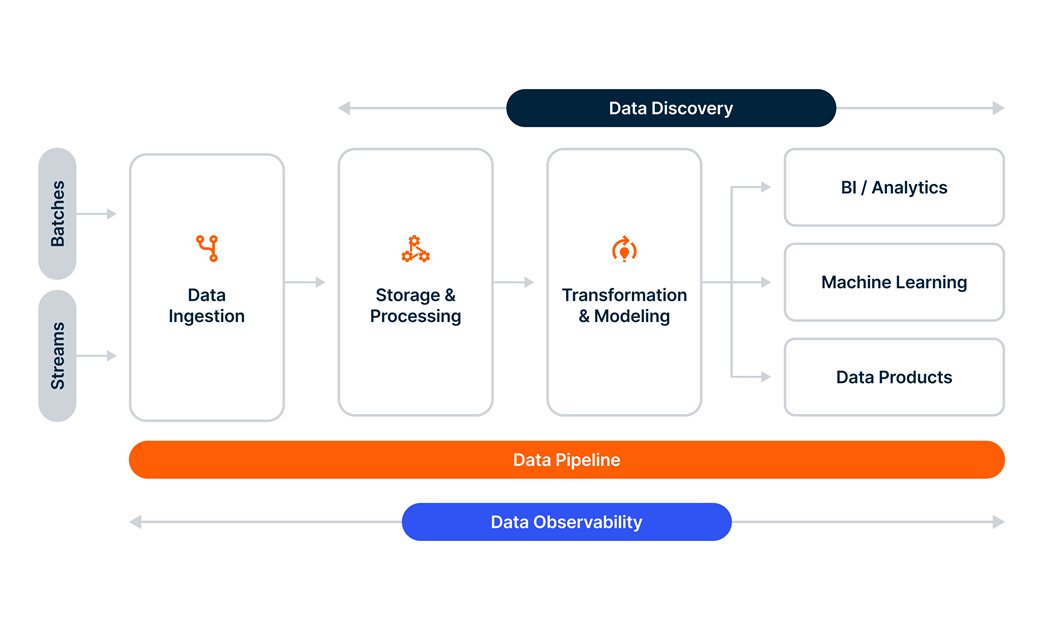 Source: https://www.montecarlodata.com/blog-data-pipeline-architecture-explained
AI pipeline vs. ML pipeline vs. data pipeline
The terms data pipeline, ML pipeline, and AI data pipeline are often used interchangeably, but they describe different scopes of work. A data pipeline is the parent category: any automated flow that moves data from source to destination. An ML pipeline is a narrower concept, typically referring to the sequence of steps that transforms training data into a deployed machine learning model—feature engineering, training, validation, and deployment.
An AI data pipeline is broader than either. It encompasses the full path from raw source data through to a production AI application, including the ML pipeline as one stage within it. An AI data pipeline also extends beyond classic machine learning to support generative AI workloads, where pipelines feed vector stores for RAG rather than feature stores for predictive models. Treated this way, the AI data pipeline is the connective tissue between the enterprise data platform and every AI application built on top of it.
The 5 stages of an AI data pipeline
Most AI data pipelines, regardless of the platform they run on or the models they support, move through the same five stages. The exact names vary across vendors and frameworks, but the work being done at each stage is consistent: data is ingested, prepared, used to train or ground a model, deployed into an application, and then monitored so the cycle can continue.
Stage 1: Data ingestion
Ingestion is the point where the pipeline gathers raw data from its source systems. For AI workloads, these sources are unusually diverse. They may include transactional databases, event streams, IoT telemetry, document repositories, images, logs, and third-party APIs. AI data ingestion differs from traditional data ingestion in its tolerance for format variety and its need to handle both batch and streaming inputs in the same pipeline. Depending on the use case, ingestion may be scheduled, continuous, or triggered by upstream events—and an enterprise-grade pipeline typically supports all three patterns concurrently.
Stage 2: Data preparation and preprocessing
Once ingested, data must be prepared before it can be used by a model. This stage handles cleaning, deduplication, normalization, type conversion, and any transformations required to bring disparate sources into a consistent shape. For machine learning workloads, preparation also includes feature engineering—deriving the variables a model will learn from. For generative AI workloads, preparation extends to chunking long documents into retrievable passages and generating vector embeddings that can be indexed for semantic search. Preparation is typically the most computationally expensive stage of the pipeline and often the most time-consuming to build and maintain.
Stage 3: Model training or RAG indexing
At this stage, prepared data is used to build or ground the model. For traditional machine learning, training means running the data through an algorithm to produce a model that can make predictions on new inputs, supported by a feature store that holds consistent features across training and inference. For generative AI, this stage takes a different form: instead of training a foundation model from scratch, prepared data is loaded into a vector store or retrieval index, where it can be used to ground an existing model's responses in enterprise context. Both paths converge on the same requirement—the data used at this stage must be tightly versioned, fully traceable, and reproducible.
Stage 4: Deployment and serving
Once a model has been trained or an index has been built, it moves into production. Deployment is the handoff from the training environment to the serving infrastructure that end users or applications will call. For predictive models, this means exposing inference endpoints and ensuring the same features available during training are available in production. For generative AI, this means making the vector store and retrieval logic available to the application layer. Deployment is also the point where the pipeline's freshness and latency requirements become non-negotiable: users and applications notice stale data and slow responses immediately.
Stage 5: Monitoring and observability
The final stage is where the pipeline earns its keep over time. Monitoring covers both pipeline health—are jobs running, is data arriving, are SLAs being met—and model health, including data drift, prediction drift, and accuracy degradation. Observability in an AI pipeline goes beyond what is required for a traditional data pipeline because the failure modes are more subtle: a model can continue to produce output that looks normal while silently losing accuracy as the underlying data distribution shifts. Monitoring is also what closes the loop back to ingestion and training, feeding retraining signals and fresh data into the next cycle.
AI data pipeline vs. traditional data pipeline
A traditional data pipeline and an AI data pipeline share the same basic building blocks—ingestion, transformation, storage, and delivery—but they are engineered for different outcomes. A traditional pipeline exists to produce a report, a dashboard, or a query-ready table. Its success is measured by how reliably it delivers structured, curated data to human analysts on a predictable schedule. An AI data pipeline, in contrast, exists to produce a model that performs well in production. Its success is measured by model accuracy, grounding quality, and the speed with which new data can be reflected in both.
This difference shapes almost every design decision downstream. Traditional pipelines favor schema-on-write rigor because analysts need consistent columns; AI pipelines favor schema flexibility because a useful training dataset often draws from documents, images, and logs that resist fixed schemas. Traditional pipelines are typically scheduled; AI pipelines are typically continuous, because models degrade without fresh data. The two patterns are not competing—they are complementary. Most enterprises run traditional pipelines to serve their analytics workloads and AI data pipelines to serve their model workloads, with the AI pipeline extending and reusing the governance, storage, and lineage that the traditional pipeline already provides.
Use a traditional data pipeline when:
- Consumers are dashboards, reports, or operational analytics
- Data is primarily structured and the schema is stable
- Refresh cadence is scheduled and predictable
- Compliance and auditability are the primary governance requirements
Use an AI data pipeline when:
- Consumers are machine learning models, large language models, or AI applications
- Data includes unstructured or multimodal content such as text, images, audio, or documents
- Models require continuous retraining or real-time grounding
- Model lineage and retraining audit are required alongside standard data audit
AI data pipeline architecture
There is no single correct architecture for an AI data pipeline. The right design depends on the workload profile—whether the pipeline supports predictive modeling, generative AI, or both; whether inference is real-time or batch; and how strict the enterprise's governance and cost constraints are. Most production AI pipelines combine several architectural patterns rather than committing to any one of them.
Batch, streaming, and hybrid patterns
Batch pipelines move large volumes of data on a schedule and are well suited to model training, where consistency matters more than freshness. Streaming pipelines move data continuously and are well suited to inference features, where a model serving a live application needs the latest signal available. Most real-world AI systems use a hybrid pattern, sometimes described as lambda or kappa architecture, in which a streaming path handles real-time requirements and a batch path handles deeper historical aggregations. A hybrid pattern is more complex to operate but reflects the actual shape of most enterprise AI workloads, where neither pure batch nor pure streaming is sufficient on its own.
Storage and compute considerations
AI pipelines touch a wider range of storage systems than traditional pipelines. Raw data typically lands in object storage. Governed analytical data is held in a data warehouse or lakehouse. Machine learning features are managed in a feature store so that the same features are available during both training and inference. Generative AI workloads add a vector store to the list, where embeddings are indexed for retrieval. On the compute side, training stages increasingly rely on GPU or accelerator hardware, while serving stages may mix CPU-based inference, GPU-based inference, and retrieval-augmented generation calls to external foundation models. Architectural decisions at this layer have direct cost implications and are among the most difficult to change once in production.
Governance, lineage, and access controls
Governance in an AI data pipeline is not an overlay—it is a design property. Every stage of the pipeline must answer three questions: which data was used, which transforms were applied, and who is authorized to access the output. Data lineage tracks the first two. Access controls enforce the third. Model lineage extends these requirements by tying a specific model version to the specific data version and pipeline run that produced it, which is what makes training runs reproducible and model behavior auditable. In regulated industries, governance at this depth is not optional. In every industry, it is the difference between a pipeline that can be trusted in production and one that cannot.
Building enterprise-grade AI data pipelines
Moving an AI data pipeline from prototype to production is where most AI initiatives discover their real challenges. A pipeline that works on a laptop with clean sample data behaves very differently when it is asked to handle enterprise-scale volumes, regulated data, and models that require continuous retraining. Enterprise-grade AI pipelines are distinguished less by the tools they use than by the disciplines they enforce.
Data quality and readiness
A model is only as good as the data it is trained and grounded on. Data quality checks must be built into the pipeline itself, not applied as a separate step after the fact. For AI workloads, quality extends beyond traditional dimensions such as completeness and accuracy. It includes bias checks, representativeness of training samples, and recency—ensuring the data reflects the world the model will operate in. A pipeline that silently passes low-quality data through to a model produces a model that silently underperforms.
Model lineage and governance
Reproducibility is what separates a production AI system from a demonstration. Knowing exactly which training data version, which transforms, and which pipeline run produced a given model is a non-trivial engineering problem—training introduces non-determinism that ordinary data lineage does not have to account for. Enterprise-grade pipelines treat model lineage as a first-class artifact, linked to the data lineage that produced it and to the deployment record that put it in production. This is what allows a model to be audited, rolled back, and retrained with confidence.
Cost predictability and retraining cadence
AI pipeline costs are harder to forecast than traditional pipeline costs because they include variable GPU usage, inference volume, and the price of external foundation model calls. Retraining cadence is the single largest cost lever most teams have: training too often wastes compute, training too rarely allows accuracy to degrade. An enterprise-grade pipeline makes retraining cadence an explicit design decision rather than an operational habit, and it instruments cost and accuracy together so the tradeoff can be managed intentionally.
Security and access controls
Training data often contains the most sensitive information in the organization—customer records, transaction histories, internal documents, and proprietary knowledge. Access to training data deserves the same rigor as access to the production database itself. Enterprise-grade pipelines enforce role-based access controls at every stage, encrypt data in transit and at rest, and audit every read of training data. The same controls extend to the models themselves: a model trained on sensitive data is a carrier of that data and must be governed accordingly.
What's next: AI in the pipeline
The pipelines described so far exist to serve AI. A newer pattern, often called AI ETL or AI-native data pipelines, turns this around: the pipeline itself is built with AI embedded inside it. In an AI ETL pattern, large language models are used inside the pipeline to perform schema mapping, detect anomalies, infer data types, suggest transformations, and in some cases repair broken jobs without human intervention.
This is an early category, not a settled one. The most reliable near-term use cases are in metadata work—classifying unstructured documents, proposing lineage relationships, and drafting transformation logic for human review. The more ambitious vision, in which pipelines self-heal and self-optimize with minimal operator input, is still maturing. Either way, the direction of travel is clear: AI is moving from being only the consumer of the data pipeline to being a component inside it.
Frequently asked questions
Still have questions about AI data pipelines? Here are answers to some of the most common.
What is an AI data pipeline?
What is an AI data pipeline?
An AI data pipeline is an automated system that ingests, prepares, and delivers data to train, ground, and operate artificial intelligence and machine learning models. It extends the traditional data pipeline with the additional stages, governance, and monitoring required to support models in production.
What are the stages of an AI data pipeline?
What are the stages of an AI data pipeline?
Most AI data pipelines move data through five stages: ingestion, preparation, training or RAG indexing, deployment, and monitoring. Ingestion gathers raw data from source systems. Preparation cleans and transforms it. Training or indexing uses it to build a model or populate a retrieval index. Deployment puts the model into production. Monitoring tracks both pipeline and model health and feeds signals back into the next cycle.
What is the difference between an AI pipeline and a traditional data pipeline?
What is the difference between an AI pipeline and a traditional data pipeline?
A traditional data pipeline is optimized to deliver structured data to dashboards, reports, and analytics tools. An AI data pipeline is optimized to deliver data—often unstructured or multimodal—to machine learning and generative AI models. It enforces tighter lineage, supports continuous retraining, and monitors both data and model health. Most enterprises run both, with the AI pipeline extending the governance and storage provided by the traditional pipeline rather than replacing it.
What are common AI data pipeline tools?
What are common AI data pipeline tools?
AI data pipelines draw on several categories of tooling. Ingestion and orchestration tools move data from source to destination. Data preparation and feature engineering tools clean and shape data for models. Feature stores and vector stores manage the inputs used for training, inference, and retrieval-augmented generation. Observability tools track pipeline health, data drift, and model drift. Most production pipelines combine several of these categories rather than relying on a single end-to-end platform.
What does an AI data pipeline architecture diagram look like?
What does an AI data pipeline architecture diagram look like?
A typical AI data pipeline architecture diagram shows a horizontal flow of five stages—ingestion, preparation, training or indexing, deployment, and monitoring—with a feedback arrow from monitoring back into training. Source systems feed into ingestion on the left; applications and users consume the outputs on the right; governance, lineage, and access controls run as a horizontal layer beneath all five stages.
How is a pipeline used in machine learning?
How is a pipeline used in machine learning?
A pipeline in machine learning is the sequence of automated steps that transforms raw training data into a deployed model. Typical steps include feature engineering, training, validation, deployment, and monitoring. In a broader AI data pipeline, the machine learning pipeline is one stage—the training or indexing step—within a longer chain that begins at ingestion and ends at production monitoring.