Overview
AI data modeling is the discipline of structuring, relating, and preparing enterprise data so that artificial intelligence and machine learning systems can use it reliably at scale. It extends traditional data modeling — the conceptual, logical, and physical design of data — with an AI-specific layer: features, embeddings, vector structures, and the lineage required for governed AI.
As enterprises move from AI experimentation to production, the quality of the underlying data model increasingly determines whether models are accurate, explainable, and trustworthy. Read on for a full definition of AI data modeling, the four types used in AI workloads, the principles that separate AI-ready data from general-purpose data, a comparison to traditional data modeling, and how leading enterprises approach it at scale.
What is AI data modeling?
AI data modeling is the process of structuring enterprise data so that artificial intelligence and machine learning systems can consume it with accuracy, consistency, and traceability. It encompasses the conceptual, logical, and physical design of data—the same three layers that underpin traditional data modeling—plus an additional layer dedicated to the features, embeddings, and vector structures that AI workloads depend on.
Modeling in AI is often confused with two adjacent concepts. The first is traditional data modeling, which focuses on representing business entities, attributes, and relationships for applications, reporting, and general-purpose analytics. The second is AI models themselves—the large language models, neural networks, and other algorithms that consume data to generate predictions or outputs. These machine learning models are the product; AI data modeling is the preparation that makes them possible.
AI data modeling is the bridge between the two. It takes the rigor of traditional modeling—entities, relationships, integrity—and extends it with the structures, methods, and governance that AI workloads require. Without it, AI initiatives stall on unreliable training data, unexplainable outcomes, and models that cannot be reproduced or audited.
Can AI do data modeling?
Yes—AI can automate significant portions of data modeling, but it does not replace the practice. AI-assisted data modeling tools can auto-generate schemas from source systems, suggest relationships between entities, infer data types, and reverse-engineer existing databases into logical models. These capabilities meaningfully accelerate the mechanical work of modeling.
What AI cannot do is validate business semantics, enforce governance policies, or determine which data matters for a given use case. A schema generated by AI still needs a human data architect to confirm that the entities reflect how the business actually operates, that the relationships carry the right meaning, and that the model serves the intended analytical or AI outcome. In practice, AI and human data architects work in tandem: AI removes the repetitive overhead, and the architect directs the strategy.
The 4 types of data modeling used for AI
AI data modeling techniques progress from business intent to AI-ready structure across four types. The first three are familiar from traditional data modeling; the fourth is AI-specific and is where enterprises most often underinvest.
Conceptual modeling
Conceptual modeling defines the high-level entities, relationships, and business questions that an AI initiative needs to answer before any data is collected or loaded. For AI workloads, this step is particularly important because it determines what outcomes the models are meant to produce—demand forecasts, fraud predictions, customer propensity scores — and works backward to the data those outcomes will require. A strong conceptual model prevents teams from training accurate models on the wrong questions.
Logical modeling
Logical modeling translates the conceptual model into a normalized, platform-agnostic structure of entities, attributes, and relationships. For AI, the integrity of the logical model has a direct impact on training data quality: inconsistent definitions across source systems become inconsistent features across models. A well-designed logical model provides a single, authoritative definition of each entity — customer, transaction, asset — that AI systems can reference without ambiguity.
Physical modeling
Physical modeling determines how the logical model is stored, partitioned, and accessed on a specific platform. For AI workloads, the physical design carries two demands beyond traditional analytics: training jobs that scan large volumes of historical data at high throughput, and inference workloads that require low-latency feature lookups. The physical model is where decisions about in-database compute, partitioning strategy, and storage format translate directly into model training speed and inference cost.
Feature modeling
Feature modeling is the AI-specific layer. It defines the derived variables—features, embeddings, and vector representations—that machine learning algorithms actually consume. A feature might be a rolling seven-day average of a customer's transactions, a vector embedding of a support ticket's text, or a categorical encoding of a product hierarchy. Feature modeling formalizes how these derived structures are named, calculated, stored, and reused across models, typically in a feature store. Without it, organizations end up with dozens of teams independently recomputing the same features—a hidden tax on AI productivity and a leading cause of inconsistent model behavior.
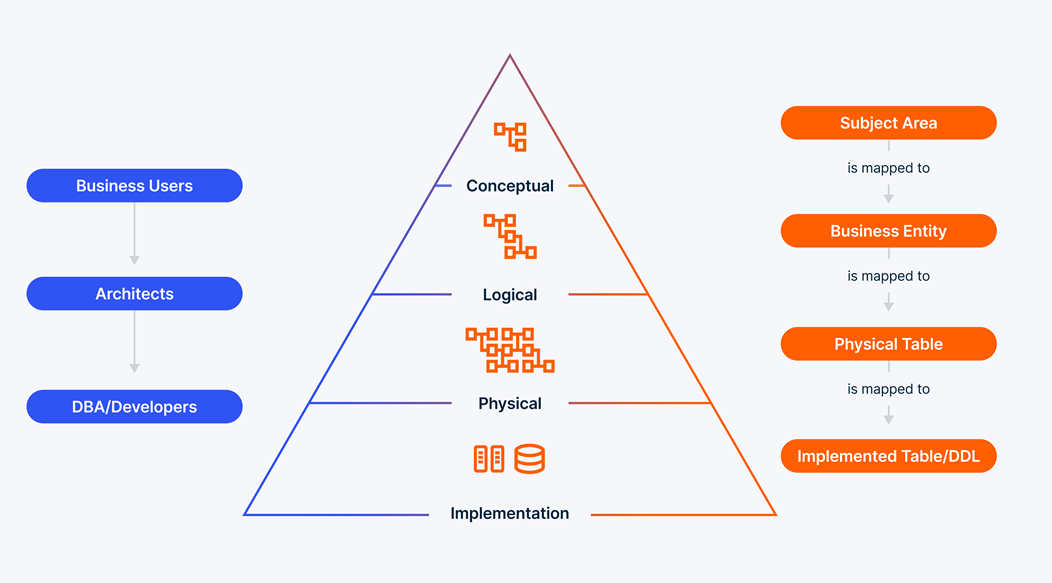 Source: https://www.theregister.com/2007/06/14/data_modelling_layers/
Key principles of data modeling for AI
The principles of data modeling for AI extend the fundamentals of traditional modeling with requirements specific to machine learning and generative AI workloads. Five principles consistently separate AI-ready enterprise data from general-purpose enterprise data.
Data quality and lineage
AI models amplify the quality—or the flaws—of the data they train on. Errors that a business intelligence report would absorb with minor inaccuracy become systematic biases in a production model. AI data modeling treats data quality and lineage as first-order design requirements rather than downstream cleanup. This means building lineage into the model itself: every feature and every training dataset can be traced back to the source systems, the transformations applied, and the point in time the data was captured.
Feature engineering and reuse
The most expensive work in AI is not training models; it is engineering the features those models consume. AI data modeling establishes shared, governed definitions of features so that multiple models—and multiple teams—can reuse them without duplication. Feature stores, consistent naming conventions, and shared transformation logic turn features into an organizational asset rather than a per-project expense.
Scale and in-database performance
Enterprise AI workloads operate on volumes of data that make traditional data movement impractical. Moving terabytes of training data between the warehouse, a feature engineering environment, and a training cluster introduces latency, cost, and reproducibility problems. A well-designed AI data model is compute-aware: it supports in-database feature engineering, training, and scoring wherever possible, keeping data stationary and letting compute run where the data already lives.
Explainability and traceability
Model explainability has become a common requirement, but data explainability is equally important and often overlooked. AI data modeling makes it possible to answer a basic but critical question: which data trained this model, when, and from which source? This is the foundation of model governance, regulatory response, and the ability to reproduce results months or years after a model was deployed.
Industry alignment
General-purpose data models force enterprises to rebuild the same foundational structures—customer, product, transaction, claim, network event—for every AI initiative. Aligning the data model with a proven industry blueprint collapses that starting cost and gives AI teams a validated schema to build on from day one.
Traditional data modeling vs. AI data modeling
Traditional data modeling and AI data modeling share the same foundational practices, but they diverge on several dimensions that matter for how enterprise data is built, governed, and consumed. The table below summarizes the key differences.
Traditional data modeling remains essential for reporting, applications, and governed analytics. AI data modeling does not replace it — it extends the same foundation to meet the additional demands of machine learning and generative AI workloads.
Enterprise considerations for AI data modeling
Enterprises face a set of AI data modeling challenges that do not appear in smaller-scale or greenfield environments. Addressing them early determines whether AI initiatives scale or stall.
- Legacy schema debt. Most enterprises already have decades of investment in operational and analytical data models. AI initiatives rarely justify rebuilding these from scratch. The practical path is to extend existing models with AI-specific layers — feature definitions, training views, vector extensions — rather than replace them.
- Hybrid structured and vector modeling. Enterprise AI workloads routinely require both traditional structured data (customer records, transactions, product hierarchies) and vector data (text embeddings, image representations). A modern AI data model must accommodate both paradigms in a single, coherent structure rather than treating them as separate systems.
- Training-data lineage across the AI lifecycle. Regulated industries increasingly require organizations to answer, on demand, exactly which data a production model was trained on. Training-data lineage cannot be retrofitted after deployment; it must be designed into the data model from the start.
- Organizational seams between data engineering and data science. In most enterprises, data engineers own the data model and data scientists own the features. Without shared definitions and governed handoffs, features drift apart from their source data, models become unreproducible, and teams waste cycles reconciling versions. AI data modeling formalizes the interface between the two disciplines.
Industry data models as AI accelerators
Most enterprises rebuild 60% to 70% of their domain model from scratch for every new AI initiative. Pre-built industry data models collapse that starting cost by providing a validated, third-normal-form blueprint of how data is organized within a specific industry.
Teradata provides industry data models developed from decades of enterprise engagements and validated with customers in each vertical:
- Teradata Financial Services Logical Data Model (FSLDM) — a comprehensive blueprint for banking, insurance, and capital markets covering customer, product, transaction, and risk domains.
- Teradata Communications Data Model (CDM) — a telecommunications-specific model covering subscriber, network, usage, and billing data.
- Teradata Healthcare Industry Data Model — a model designed for payer, provider, and life sciences data.
Used as accelerators, these industry data models shorten AI time-to-value from quarters to weeks by eliminating the foundational modeling work and providing a consistent starting point that data engineering and data science teams can extend together.
How Teradata approaches AI data modeling
Teradata's approach to AI data modeling brings together four capabilities that enterprise AI workloads require: pre-built industry data models as starting points, in-database feature engineering, end-to-end training and scoring without data movement, and governance and lineage designed for AI. Organizations using this approach model their data once and reuse it across analytics, machine learning, and generative AI workloads—keeping data, features, and models consistent across the enterprise.
Frequently asked questions on AI data modeling
Still have questions about AI data modeling? Here are answers to some of the most common.
Can AI do data modeling?
Can AI do data modeling?
Yes, AI can automate significant portions of data modeling—including schema generation, relationship inference, and database reverse engineering—but it does not replace human data architects. Validating business semantics, enforcing governance, and aligning the model to specific use cases still require human judgment. In practice, AI and data architects work together: AI handles repetitive mechanical work, architects direct the strategy.
What are the four types of data modeling?
What are the four types of data modeling?
The four types of data modeling used for AI are conceptual, logical, physical, and feature modeling. Conceptual modeling defines business entities and relationships; logical modeling normalizes them into a platform-agnostic structure; physical modeling determines how they are stored and accessed; feature modeling defines the derived variables, embeddings, and vectors that AI systems consume directly.
What is the difference between data modeling and AI data modeling?
What is the difference between data modeling and AI data modeling?
Traditional data modeling structures data for applications, reporting, and general-purpose analytics. AI data modeling extends that foundation with features, embeddings, vector structures, and training-data lineage specifically designed to make enterprise data consumable by machine learning and generative AI systems. Both disciplines share the same conceptual, logical, and physical layers; AI data modeling adds a fourth.
What role does historical data play in AI modeling?
What role does historical data play in AI modeling?
Historical data is the foundation of AI modeling. Machine learning models learn patterns from past observations, and the breadth, depth, and quality of historical data directly determine model accuracy. AI data modeling preserves historical data with point-in-time accuracy so that features can be reconstructed as they existed at training time—a requirement for reproducible, auditable, and governed AI.